Why Enterprises Need Commercial Threat Intelligence
In today's threat landscape, enterprises face sophisticated adversaries who operate with the resources and coordination of nation-states or organized...
6 min read
Nicholas Tan
:
February 19, 2026
As a cyber threat intelligence vendor, we've noticed a persistent confusion between Threat Intelligence, Digital Risk Protection Services (DRPS), and External Attack Surface Management (EASM). While these disciplines overlap and complement each other, conflating them can lead to gaps in your security strategy. Let's clarify what each actually does and why you need to understand the distinctions.
The confusion typically stems from the fact that all three disciplines deal with external threats and monitoring. However, treating them as interchangeable is like assuming a cardiologist, a personal trainer, and a nutritionist all do the same thing because they're concerned with heart health. Each has a distinct focus, methodology, and outcome.
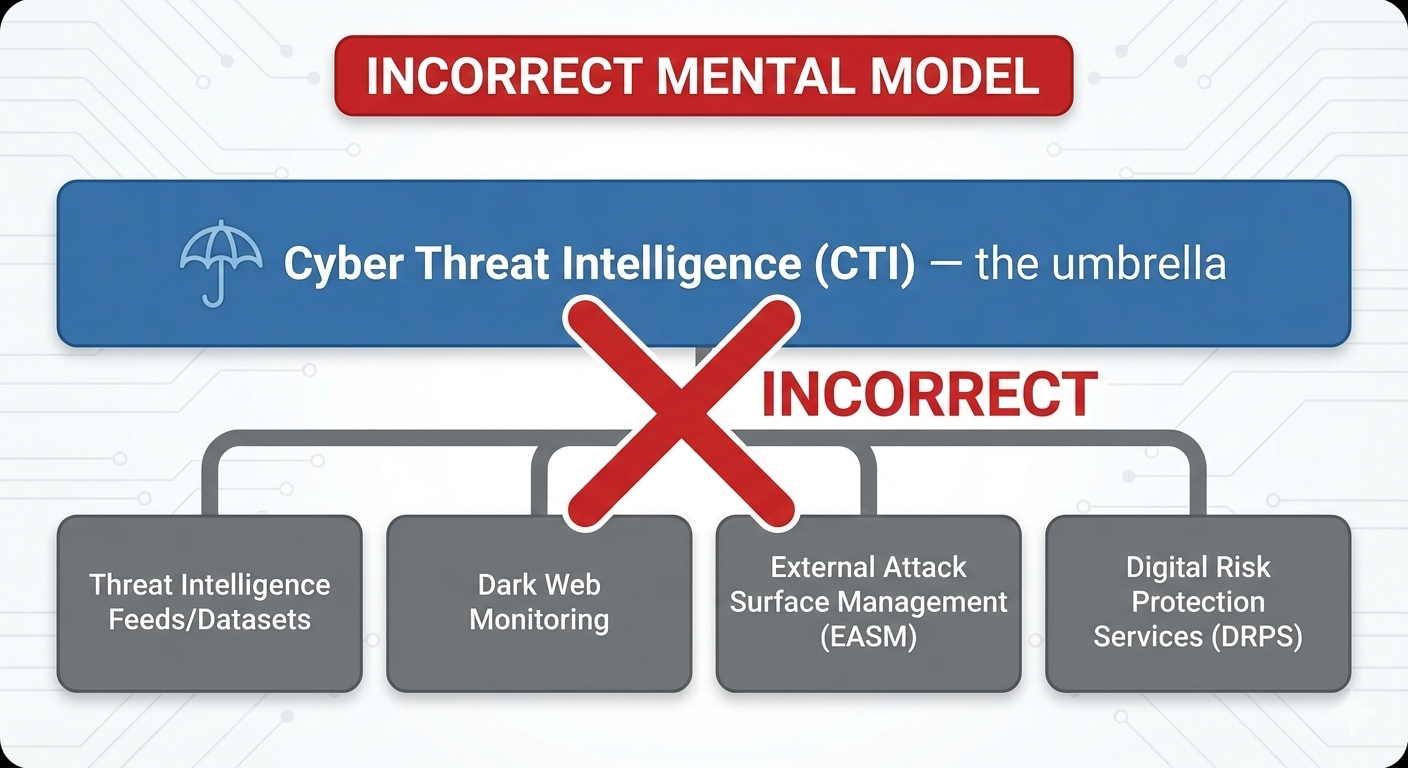
Before we dive into the definitions, there's an even more fundamental confusion I need to address: the belief that Cyber Threat Intelligence (CTI) is an umbrella term that includes DRPS, dark web monitoring, EASM, and threat data feeds.
This is incorrect, yet it's surprisingly common.
I've seen organizations procure "CTI platforms" expecting comprehensive dark web monitoring, asset discovery, and brand protection—only to discover they've purchased a threat intelligence aggregation tool. Conversely, I've seen teams invest in dark web monitoring services and assume they now have a complete CTI program.
Here's the reality:
Cyber Threat Intelligence is NOT a catch-all category. It's a specific discipline focused on understanding adversaries, their capabilities, motivations, and tactics. While CTI may consume data from dark web monitoring, EASM, or DRPS tools, these are separate functions with distinct purposes.
Many people incorrectly visualize the relationship like this:
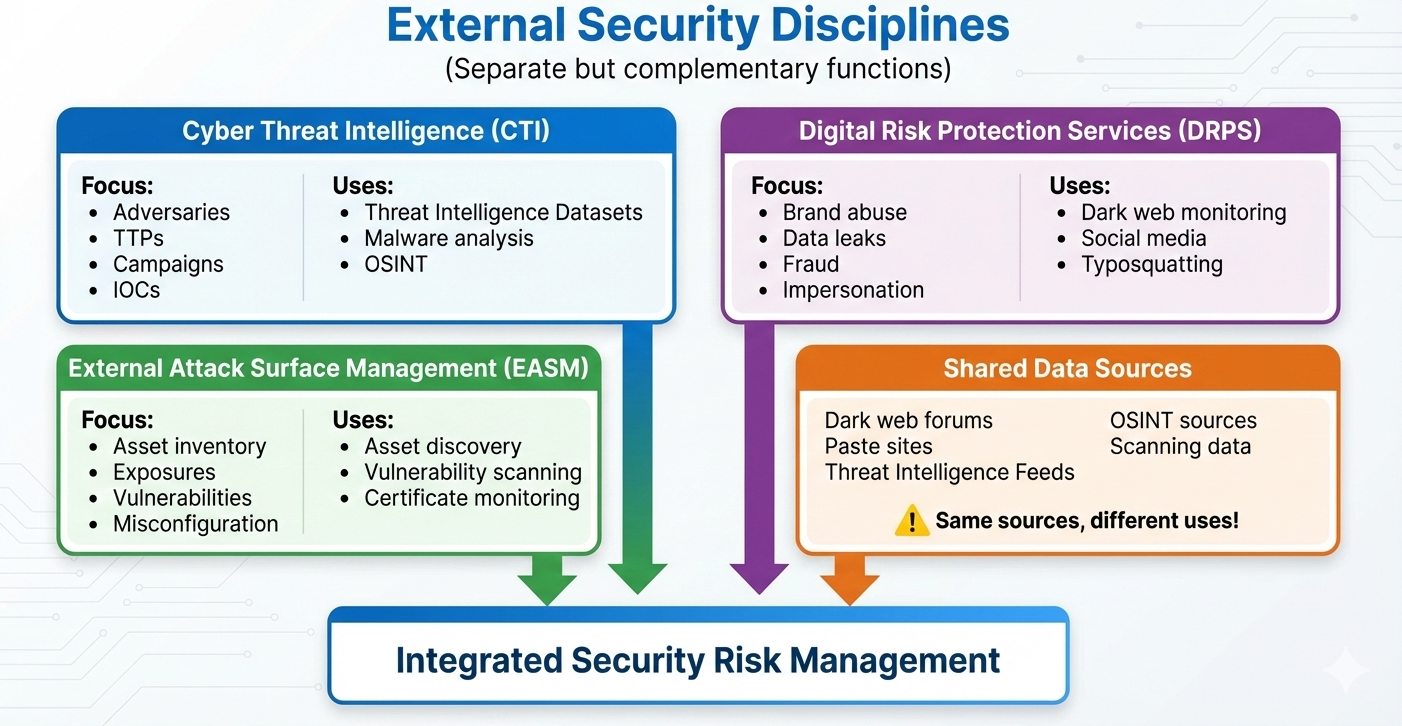
However, the relationship is more nuanced; with each being a seperate but complentary function.
Believing CTI encompasses everything external can lead to:
Dark web monitoring is frequently—and incorrectly—treated as synonymous with CTI. Here's the distinction:
Dark web monitoring is primarily a DRPS function. It searches forums, marketplaces, and paste sites for:
CTI may use dark web sources, but for different purposes:
Same data source, completely different use cases and outcomes.
Think of it this way: both a crime analyst and a victim advocate might read police reports, but they use that information for entirely different purposes. The data source overlaps, but the disciplines don't merge into one.
Threat Intelligence (or Cyber Threat Intelligence - CTI) is the collection, analysis, and dissemination of information about current and emerging threats that could harm your organization. It's about understanding the "who, what, when, where, why, and how" of cyber threats.
Core characteristics:
Practical example: Threat intelligence might alert you that a ransomware group is targeting organizations in your industry using a specific vulnerability in software you use. This allows you to prioritize patching and prepare incident response procedures.
DRPS monitors the broader digital ecosystem to identify risks to your brand, reputation, data, and operations beyond your immediate infrastructure. It looks outward at how your organization appears and is being discussed or exploited across the internet.
Core characteristics:
Practical example: DRPS might discover that someone has created a fake LinkedIn profile impersonating your CEO to conduct business email compromise attacks, or that customer credentials from a third-party breach are being sold on underground forums.
EASM focuses on continuously discovering, inventorying, and assessing all your internet-facing digital assets to identify vulnerabilities and misconfigurations that attackers could exploit.
Core characteristics:
Practical example: EASM might reveal that a development server created three years ago is still publicly accessible with outdated software, or that an acquisition's IT infrastructure was never properly integrated and contains critical vulnerabilities.
These disciplines overlap in several ways:
Here's where they diverge:
A mature cybersecurity program doesn't choose between these disciplines — it integrates them:
Threat Intelligence tells you a credential-harvesting campaign is targeting your industry. DRPS discovers that stolen credentials from your employees are being sold online. EASM identifies that you have an exposed authentication portal that doesn't enforce multi-factor authentication, making those stolen credentials particularly dangerous.
See how they work together? Each provides a piece of the puzzle that the others cannot.
Here's another scenario: EASM finds an outdated web server with a critical vulnerability. Threat Intelligence reveals that a specific APT group is actively exploiting that vulnerability in your region. DRPS discovers conversations on dark web forums specifically discussing your organization as a target. Together, these inputs transform a medium-priority patch into an urgent, board-level risk.
Start with EASM if you don't have a clear picture of your external attack surface. You can't protect what you don't know exists.
Add Threat Intelligence to understand the threat landscape relevant to your industry, geography, and technology stack. This contextualizes your risk.
Implement DRPS to monitor for brand abuse, data leaks, and fraud that EASM and traditional threat intelligence won't catch.
Cyber Threat Intelligence, DRPS, and EASM are distinct but complementary cybersecurity disciplines. CTI is not an umbrella term that encompasses the others—each serves a specific, irreplaceable function in your security program.
Understanding their differences ensures you build a comprehensive external security posture rather than leaving critical gaps in your defenses. More importantly, understanding that they're separate disciplines helps you:
Don't let budget constraints force you into an either-or decision. Even basic implementations of all three will serve you better than a sophisticated deployment of just one. Start where your greatest risk lies, but plan to expand into a holistic external security strategy.
The organizations that understand these distinctions—and invest accordingly—are the ones building genuinely resilient security programs. Don't fall into the "big CTI misconception" trap. Know what you're buying, know what you're missing, and build a security posture that addresses the full spectrum of external risk.
In today's threat landscape, enterprises face sophisticated adversaries who operate with the resources and coordination of nation-states or organized...
Cyber attackers aren’t waiting. Every week, new campaigns, zero-days, and adversary tactics emerge. Security teams need more than static feeds. They...
We're thrilled to share incredible news: ThreatBook has achieved a full 5.0 out of 5 rating in 20 overall responses in the latest Gartner Peer...